Delivering Program Management Excellence: The Ultimate PgMP® Playbook
Projects deliver outputs. Programs deliver outcomes.
That difference is the reason program management has become one of the most important leadership disciplines in modern organizations. A single project may launch a platform, implement a process, or deliver a product feature. A program connects multiple related projects into a coordinated strategy that improves revenue, reduces risk, strengthens compliance, and creates measurable business value.
For experienced project managers, PMO leaders, transformation executives, and PgMP® candidates, mastering program management excellence is no longer optional. It is the bridge between ambitious strategy and repeatable execution.
This playbook explains how to build, govern, execute, measure, and improve programs that executives trust and stakeholders support.
What Is Program Management Excellence?
Program management excellence is the disciplined practice of coordinating multiple related projects to achieve strategic business outcomes.
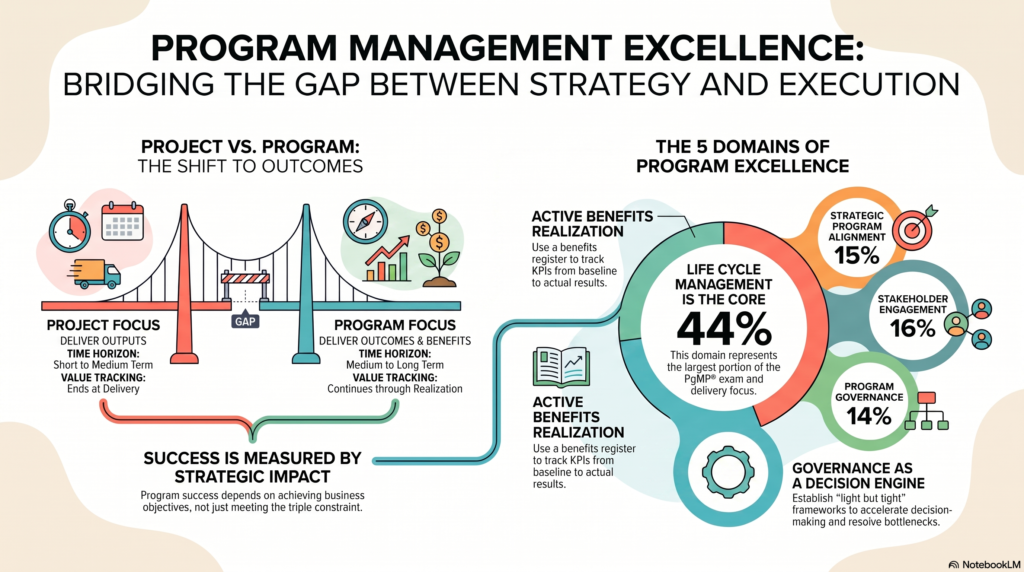
Unlike project management, which focuses on delivering defined outputs within scope, schedule, and budget, program management focuses on benefits realization, cross-project alignment, stakeholder value, and long-term organizational impact.
A strong program management approach answers questions such as:
- Are all projects contributing to the same strategic objective?
- Are dependencies being managed across teams, vendors, and business units?
- Are benefits being measured after delivery?
- Are risks visible early enough for leaders to act?
- Are governance forums making decisions fast enough?
When those answers are clear, programs stop feeling like collections of disconnected projects. They become strategic value engines.
Projects vs. Programs: The Difference Leaders Must Understand
A project delivers a specific output. A program delivers a broader business outcome.
| Dimension | Project | Program |
|---|---|---|
| Primary focus | Deliverables | Outcomes and benefits |
| Time horizon | Short to medium term | Medium to long term |
| Success measure | On time, on budget, in scope | Strategic objectives achieved |
| Scope | Defined and contained | Adaptive and interdependent |
| Governance | Project sponsor or steering group | Executive-level program governance |
| Value tracking | Often ends at delivery | Continues through benefits realization |
For example, implementing a new CRM platform is a project. Transforming the global customer experience across sales, service, data, adoption, training, reporting, and revenue operations is a program.
That shift from output to outcome is where program management excellence begins.
Why Program Management Matters More Than Ever
Organizations invest heavily in transformation, digital modernization, regulatory change, product expansion, and operational improvement. Yet many initiatives fail to deliver their promised value because workstreams become misaligned, benefits are poorly defined, and decision-making slows down when complexity increases.
Program management solves that problem by creating a coordinated structure for:
- Aligning execution with strategy
- Sequencing work around value delivery
- Managing cross-project dependencies
- Escalating risks before they damage outcomes
- Tracking benefits beyond go-live
- Giving executives a clear view of progress and trade-offs
A well-run program does not simply ask, “Did we finish the work?”
It asks, “Did the work create the business result we promised?”

The Modern Program Manager: From Coordinator to Strategic Conductor
Today’s program manager is not just a senior project manager. The role requires strategy, commercial judgment, leadership, governance, and influence.
PMI describes PgMP® certification as a credential for professionals who manage multiple projects in a coordinated way and align those efforts to strategic objectives.
That description reflects the real nature of the job. A modern program manager must translate executive ambition into delivery architecture.
Core Responsibilities of a Program Manager
A high-performing program manager typically acts as:
Strategy Translator
The program manager turns strategic priorities, business goals, OKRs, or transformation themes into a practical roadmap.
That means defining workstreams, sequencing outcomes, clarifying dependencies, and making sure every project has a reason to exist.
Benefits Owner
Programs must prove value.
A program manager tracks promised benefits against actual results using a benefits register, KPI dashboard, finance alignment, and post-implementation measurement.
Governance Leader
Program governance defines who decides, who funds, who escalates, who advises, and who is accountable.
Without clear governance, programs drift. With strong governance, leaders make faster decisions with better information.
Risk Forecaster
Project risks are local. Program risks are systemic.
A program manager identifies patterns across projects, vendors, regulatory impacts, resource constraints, technology dependencies, and stakeholder resistance.
Stakeholder Orchestrator
Programs affect many groups. Executives, regulators, vendors, product owners, finance teams, technology teams, frontline employees, and customers may all have different concerns.
Program managers create alignment before misalignment becomes resistance.
Essential Program Manager Skills for Enterprise Success
Program management excellence depends on a balanced skill set.
The most valuable program managers combine delivery discipline with strategic leadership. They can read a financial model, facilitate a conflict, simplify an executive dashboard, challenge unrealistic benefits, and motivate cross-functional teams.
Key skills include:
- Strategic planning and roadmap development
- Benefits realization management
- Executive communication
- Stakeholder engagement
- Financial and commercial acumen
- Risk management at scale
- Governance design
- Resource orchestration
- Vendor and partner management
- Change leadership
- Conflict resolution
- Data-driven reporting
The best program managers also protect time for “zoom-out thinking.” Thirty minutes each week spent reviewing dependencies, risks, benefits, and stakeholder signals can prevent months of avoidable rework.
PgMP® Certification: Is It Worth It?
The Program Management Professional PgMP® certification is designed for experienced professionals who manage multiple related projects and align them with organizational goals.
For leaders already operating at enterprise scale, PgMP® can strengthen credibility, validate experience, and demonstrate readiness for larger transformation roles.
PMI states that PgMP® certification demonstrates advanced expertise in managing multiple projects in a coordinated way and aligning results with strategic objectives. PMI also reports that 23% of surveyed PgMP® holders globally reported a salary increase after certification.
PgMP® is especially relevant for:
- Senior project managers moving into program leadership
- Program managers seeking global recognition
- PMO leaders building governance capability
- Transformation leaders managing complex initiatives
- Consultants advising enterprise change programs
PgMP® Eligibility Requirements
PgMP® eligibility depends on education and professional experience.
PMI currently lists three eligibility paths. Candidates with a secondary diploma need 48 months of project management experience or PMP® within the past 15 years, plus 84 months of program management experience within the past 15 years. Candidates with a bachelor’s degree or higher need 48 months of project management experience or PMP® within the past 15 years, plus 48 months of program management experience within the past 15 years. Candidates with a bachelor’s degree or higher from a GAC-accredited program need 36 months of project management experience or PMP® within the past 15 years, plus 36 months of program management experience within the past 15 years.
That means PgMP® is not an entry-level credential. It is designed for professionals with meaningful experience leading coordinated work across multiple related projects.
PgMP® Exam Format and Domains
The PgMP® exam includes 170 questions and allows 240 minutes. PMI lists the exam languages as English and Simplified Chinese on its PgMP® certification page.
The PgMP® examination blueprint includes five domains:
| PgMP® Domain | Percentage of Exam |
|---|---|
| Strategic Program Alignment | 15% |
| Program Life Cycle Management | 44% |
| Benefits Management | 11% |
| Stakeholder Engagement | 16% |
| Governance | 14% |
PMI’s PgMP® handbook notes that the exam contains 150 scored questions and 20 unscored pretest questions, for a total of 170 questions.
For PgMP® candidates, the best preparation strategy is scenario-based learning. Memorizing definitions is not enough. The exam tests judgment, sequencing, governance, benefits logic, stakeholder trade-offs, and decision-making under ambiguity.
How to Build a Strong Program Foundation
Every successful program starts with clarity.
Before teams build detailed schedules or fill dashboards, leaders need to answer three fundamental questions:
- Why does this program exist?
- What business outcome must it deliver?
- How will we know whether it succeeded?
Without those answers, a program becomes a collection of busy work.
Define SMART Program Objectives
Program objectives should be specific, measurable, achievable, relevant, and time-bound.
A weak objective sounds like this:
“Improve the e-commerce experience.”
A strong objective sounds like this:
“Increase global e-commerce revenue by 18% and reduce cart abandonment by 12% within 18 months through platform modernization, checkout redesign, payment expansion, and customer journey optimization.”
The second version is stronger because it connects work to business results.
Create a Program Charter That Leaders Actually Use
A program charter is the North Star for the entire program.
It should be short enough for executives to understand and detailed enough for teams to act on.
A strong program charter includes:
- Purpose and strategic rationale
- Business outcomes and success criteria
- Scope boundaries
- Key benefits and KPIs
- Major workstreams
- Executive sponsor
- Governance forums
- High-level roadmap
- Budget envelope
- Key risks and assumptions
A simple test: can the executive sponsor explain the program in two sentences?
If not, the charter needs more work.
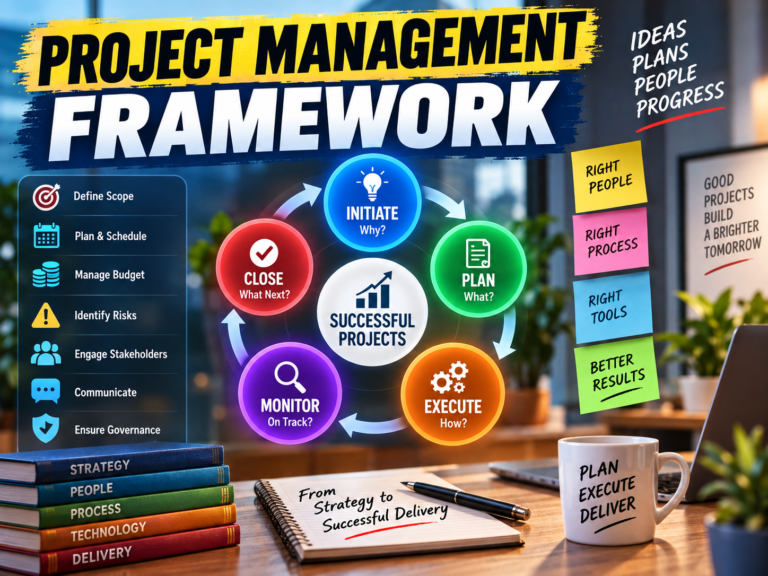
Build a Program Governance Framework
A program governance framework defines how decisions are made, escalated, funded, and documented.
This is where many programs either accelerate or stall.
A “light but tight” governance model includes:
Executive Steering Committee
The steering committee handles strategic direction, funding decisions, major scope trade-offs, priority conflicts, and benefit protection.
Program Management Office
The PgMO or program office maintains standards, reporting cadence, risk governance, dependency tracking, and decision logs.
Change Control Board
The CCB reviews material changes to scope, cost, timeline, risk, and benefits.
Finance representation is especially valuable because change decisions often affect the business case.
RASCI Matrix
A RASCI matrix clarifies who is Responsible, Accountable, Supporting, Consulted, and Informed.
This reduces confusion and prevents decision bottlenecks.
Strategy and Planning: How to Keep Programs Off the Critical Path
Program planning is not paperwork. It is risk prevention.
The goal is not to create a perfect plan. The goal is to create a living model of how value will be delivered, what must happen first, and where the biggest risks sit.
Conduct a Program Assessment and Gap Analysis
Before committing to timelines, conduct a practical assessment of current state and future state.
Review:
- Business capabilities
- Process maturity
- Technology readiness
- Data quality
- Vendor dependencies
- Regulatory requirements
- Team capacity
- Change readiness
- Funding assumptions
Then prioritize gaps using an impact-versus-urgency matrix.
Not every gap deserves immediate attention. The best program managers focus first on the constraints that threaten value delivery.
Use MoSCoW Prioritization to Control Scope
Scope creep is one of the fastest ways to erode program benefits.
MoSCoW prioritization helps teams classify requirements into:
- Must have: Essential for business value, compliance, or viability
- Should have: Important but not mandatory for the first value drop
- Could have: Useful enhancements
- Will not have: Explicitly excluded for now
The key is to tie every deliverable to a benefit. If a feature, process, or milestone does not support a defined outcome, challenge it.
Build an Integrated Master Schedule
An Integrated Master Schedule, or IMS, provides a connected view of workstreams, milestones, dependencies, decision points, and critical path.
A strong IMS should show:
- Product milestones
- Technology releases
- Data dependencies
- Change management activities
- Vendor deliverables
- Governance gates
- Training waves
- Regulatory checkpoints
- Benefits measurement points
For executive reporting, simplify the view. Leaders do not need a 900-line Gantt chart. They need to know what is on track, what is at risk, what decision is needed, and what value is protected.
Program Risk Management: See Around Corners
Risk management at program level requires more than a risk log.
It requires structured scanning, early escalation, ownership, and decision discipline.
A proactive program risk management process includes four steps:
- Identify: Use workshops, interviews, retrospectives, dependency reviews, and lessons learned.
- Assess: Score probability, impact, proximity, and detectability.
- Treat: Avoid, transfer, reduce, accept, or escalate.
- Monitor: Review weekly with clear owners and due dates.
One practical rule: if Cost Performance Index or Schedule Performance Index drops below an agreed threshold, escalation should happen automatically.
That removes politics from reporting and makes the system safer for teams.
Quality Management Across Program Deliverables
Program quality is not just testing at the end.
It is the deliberate design of standards, controls, reviews, and feedback loops across all workstreams.
A quality management approach should include:
- Quality standards and acceptance criteria
- Gate reviews at major transitions
- Automated testing where possible
- Security and performance validation
- Defect trend monitoring
- Operational readiness checks
- Customer or user acceptance testing
- Post-release review
Quality should be built into delivery, not inspected after failure.
Change Control Without Slowing Innovation
Program change is inevitable. The goal is not to eliminate change. The goal is to control it intelligently.
A lightweight change control process should ask:
- Why is this change needed?
- What benefit does it support?
- What is the cost impact?
- What is the schedule impact?
- What risks does it introduce or reduce?
- Does it affect the business case?
- Who must approve it?
Low-impact changes can be bundled into monthly release windows. High-impact changes should go to the CCB with a clear recommendation.
A good change process protects both agility and accountability.
Stakeholder Engagement That Creates Buy-In
The fastest way to stall a program is to surprise an influential stakeholder.
Stakeholder engagement must begin early and continue throughout the program lifecycle.
Start with a power-interest grid:
| Stakeholder Type | Engagement Strategy |
|---|---|
| High power, high interest | Treat as co-designers |
| High power, low interest | Keep satisfied with concise updates |
| Low power, high interest | Keep informed through demos and forums |
| Low power, low interest | Monitor with periodic communication |
This simple tool helps program leaders decide where to invest time and attention.
Build a Communication Cadence That Supports Decisions
Communication should not be noise. Every report, meeting, and dashboard should help someone make a better decision.
A useful cadence might look like this:
| Audience | Channel | Frequency | Key Metric |
|---|---|---|---|
| Executive sponsor | Steering deck | Monthly | Benefits realized |
| Product owners | Kanban and standups | Daily | Throughput and blockers |
| End users | Demos and beta forums | Bi-weekly | Adoption and satisfaction |
| Finance | Benefits scorecard | Quarterly | ROI versus plan |
| Delivery leads | Risk and dependency review | Weekly | Critical path health |
A simple principle: if a metric does not change a decision, it does not belong on the executive slide.
Conflict Resolution in Program Management
Conflict is normal in complex programs.
Teams may disagree about priorities, funding, technical decisions, timelines, or risk appetite. The program manager’s role is not to avoid conflict. It is to make conflict productive.
A practical conflict resolution model:
- Listen for the interest behind the position.
- Reframe the conversation around shared objectives.
- Identify trade-offs openly.
- Use data where possible.
- Document the decision, owner, and due date.
- Revisit the decision if assumptions change.
Healthy debate improves programs. Hidden disagreement weakens them.
Leading High-Performing Program Teams
People deliver programs, not templates.
A high-performing program team needs clarity, trust, autonomy, and accountability. The program manager sets the tone.
Strong leaders:
- Remove blockers quickly
- Create psychological safety
- Encourage transparent risk reporting
- Reward collaboration
- Coach workstream leads
- Protect teams from unnecessary executive churn
- Celebrate smart trade-offs, not heroic burnout
Look for T-shaped talent: people with deep expertise in one area and enough breadth to collaborate across functions.
Program Execution and Control: Real-Time Visibility Without Micromanagement
Execution control is not about hovering over teams.
It is about creating early visibility so leaders can act before problems become expensive.
A strong execution system includes:
- Clear workstream ownership
- Weekly risk and dependency reviews
- Automated dashboards
- Defined escalation thresholds
- Decision logs
- Benefits scorecards
- Change control discipline
- Vendor performance tracking
Control should make delivery easier, not heavier.
Program KPIs and Earned Value Metrics
Program dashboards should combine delivery health and business value.
Useful metrics include:
- Earned Value
- Cost Performance Index
- Schedule Performance Index
- Benefits realized versus planned
- Critical dependency status
- Top risks
- Defect trends
- Adoption rate
- Customer satisfaction
- Operational readiness
- Budget burn
- Decision aging
Earned value formulas can be useful when applied consistently:
- EV = % complete × Budget at Completion
- CPI = Earned Value ÷ Actual Cost
- SPI = Earned Value ÷ Planned Value
- Benefits realization = Actual value ÷ Planned value
The goal is not to drown leaders in numbers. The goal is to show the few indicators that reveal whether value is still on track.
Benefits Realization: The Heart of Program Management Excellence
Benefits realization is what separates program management from large-scale task coordination.
A benefits register should include:
- Benefit name
- KPI
- Baseline
- Target
- Owner
- Due date
- Actual result
- Confidence level
- Measurement method
Example:
| Benefit | Metric | Baseline | Target | Owner | Confidence |
|---|---|---|---|---|---|
| Revenue uplift | ARPU | $42 | $48 | CCO | Medium |
| Cost reduction | Cloud unit cost | $1.00 | $0.75 | CTO | High |
| Customer retention | 90-day churn | 7.8% | 6.5% | CPO | Medium |
| Compliance improvement | Audit findings | 12 | 3 | CRO | Improving |
Benefits should be reviewed at every steering committee meeting. When benefits are only measured at the end, it is usually too late to protect them.
Program Closure: How to Bank the Win
Program closure is more than administrative cleanup.
It is the point where the organization confirms delivery, captures learning, transitions ownership, and validates value.
A structured closure checklist includes:
- Confirm final deliverables against acceptance criteria
- Obtain sponsor and business owner sign-off
- Close contracts and financial records
- Archive documentation and decision logs
- Transfer ownership to operations
- Release resources
- Confirm benefits tracking owners
- Run final retrospectives
- Publish lessons learned
- Celebrate the team’s contribution
A program is not truly closed until operational ownership is clear and benefits measurement continues.
Lessons Learned and Continuous Improvement
Every program should make the next program easier.
That only happens when lessons learned are captured, categorized, and reused.
Classify lessons by:
- Governance
- Scope
- Schedule
- Cost
- Risk
- Stakeholders
- Vendors
- Technology
- Change management
- Team performance
- Benefits realization
Store them in a searchable knowledge base. Short, tagged summaries are more useful than long documents nobody opens.
Continuous improvement should also include quarterly program health checks across scope, schedule, cost, risk, governance, and benefits.
PgMP® Maintenance and Career Growth
Earning PgMP® is not the end of the journey.
PMI states that PgMP® holders must earn 60 professional development units, or PDUs, in each three-year cycle to maintain certification.
Program leaders can use those PDUs strategically by focusing on areas that expand executive impact:
- Finance for program managers
- Portfolio management
- Change leadership
- Data analytics
- Product strategy
- AI-enabled delivery
- Negotiation and influence
- Governance design
- Regulatory and compliance leadership
A strong career roadmap might look like this:
Next 90 Days
Build or refresh your PgMP® study plan, complete scenario practice, and document your program experience.
Next 6–12 Months
Mentor aspiring program managers, improve your benefits tracking approach, and present a case study inside your organization or PMI community.
Next 12+ Months
Deepen commercial acumen, lead larger enterprise programs, and contribute to portfolio-level decision-making.
Executive-Ready Program Management Talking Points
Use these phrases when communicating with senior leaders:
- “We are sequencing by value drops, not by project convenience.”
- “This decision protects the benefits case.”
- “The dependency risk is now on the critical path.”
- “The program remains within cost tolerance, but benefits confidence has decreased.”
- “We need a decision this week to avoid downstream schedule impact.”
- “This change increases value, but it requires a formal re-baseline.”
- “The issue is not delivery speed; it is unresolved ownership.”
These statements frame program management as business leadership, not administrative reporting.
Quick Program Management Excellence Checklist
Use this checklist to evaluate your current program:
- Program charter approved and understood
- SMART objectives linked to business strategy
- Benefits register created and owned
- Governance forums scheduled
- RASCI matrix published
- Integrated roadmap maintained
- Critical dependencies visible
- Risk log reviewed weekly
- Change control process active
- Stakeholder map updated
- Executive dashboard automated
- CPI and SPI thresholds defined
- Lessons learned stored and searchable
- Closure plan includes benefits tracking
- PgMP® PDUs planned for the next cycle
If several items are missing, start with the charter, benefits register, governance model, and stakeholder map. Those four artifacts create immediate clarity.
Frequently Asked Questions About Program Management Excellence
Is PgMP® worth it for experienced project managers?
PgMP® can be worth it for professionals already managing multiple related projects or leading enterprise-level change. It validates program management experience and signals the ability to align complex work with strategic objectives. PMI positions PgMP® as an advanced credential for professionals who manage coordinated programs and navigate complexity.
What is the fastest way to show value in a new program?
Deliver a visible benefit within the first 60 to 90 days.
That might be a process improvement, risk reduction, cost saving, adoption milestone, or customer experience improvement. Early value builds stakeholder confidence.
How do you keep program governance light but effective?
Clarify decision rights, simplify reporting, automate dashboards, and define escalation thresholds.
Governance should accelerate decisions, not create unnecessary meetings.
What tools should a program manager standardize?
Most programs benefit from a roadmap tool, work management platform, BI dashboard, document repository, decision log, dependency tracker, risk register, and benefits scorecard.
The specific tools matter less than consistent usage and trusted data.
What is the biggest mistake in program management?
The biggest mistake is confusing delivery progress with business value.
A program can complete many milestones and still fail if benefits are unclear, unmeasured, or no longer relevant.
Conclusion: Turn Program Management Into a Value Engine
Program management excellence is a leadership discipline. It connects strategy to execution, projects to outcomes, and delivery activity to measurable value.
To build programs that executives trust, start with a sharp charter, define benefits early, establish light but effective governance, manage risk proactively, and communicate in a way that supports decisions.
Whether your goal is PgMP® certification, stronger enterprise delivery, or a more mature program governance framework, the path is the same: align the work, protect the value, lead the people, and measure what matters.
Actionable Takeaways
- Publish a one-page program charter that links strategy, scope, KPIs, governance, and benefits.
- Create a benefits register with baseline, target, owner, due date, actuals, and confidence level.
- Build a simple executive scorecard showing CPI, SPI, benefits, top risks, dependencies, and decisions needed.
- Map stakeholders using a power-interest grid and tailor communication to decision needs.
- Prepare for PgMP® with scenarios, not memorization, and focus on governance, benefits, stakeholder engagement, and lifecycle trade-offs.
References
Project Management Institute. (2024)The Standard for Program Management, Fifth Edition. Project Management Institute.
Project Management Institute. Program Management Professional PgMP® Certification. Project Management Institute. Project Management Institute
Thanks for reading the article “Program Management Excellence” and read all articles on Project Management