
Pitch Deck Metrics and Milestones: The Step-by-Step Guide Investors Actually Read
Creating a pitch deck that turns heads (and opens cheque book) is not about cramming data onto slides; it is about showing the right numbers, in the right order, wrapped in a story investors cannot forget. This guide walks you through exactly how to highlight key metrics and milestones, so your traction is obvious, your path forward is credible, and your ask feels inevitable.
You will get practical, investor-friendly advice on what to include, how to visualize it, how to calculate it, and how to tailor the story for your stage and business model plus ready-to-use templates, formulas, and slide outlines you can drop straight into your deck.
1) Why Metrics Matter (and Where Most Decks Go Wrong)
Investors are pattern seekers. They do not just want to hear that your startup is great, they want proof in the form of traction, efficiency, and durability. Metrics deliver exactly that.
Where founders often stumble:
- Vanity overload: pageviews, downloads, and impressions that do not tie to revenue or retention.
- Buzzword camouflage: hiding thin traction behind visionary roadmaps and acronyms.
Your job: select a small, powerful set of metrics that imply scale, capital efficiency, and compounding value then sequence them in a narrative that builds momentum.
Callout: If a metric does not change an investor’s conviction (up or down), it does not belong in the deck.
2) The Three Buckets of Investor-Ready Metrics
Think of your metrics like a funnel of conviction:
- Traction & Growth: Are we growing? Is demand compounding?
- Unit Economics & Efficiency: Do the economics work at scale?
- Durability & Retention: Will customers stay, expand, and refer?
Pick 1–3 metrics from each bucket (stage-appropriate) and you have your traction story.

3) Core Metrics to Include (and when)
3.1 Revenue & Growth
- MRR / ARR (SaaS & subscriptions)
- GMV (marketplaces, platforms)
- Net Revenue (commerce, transactional)
- Growth Rate (MoM / YoY)
Rule of Thumb: Show 12–24 months of trend with MoM and YoY highlights.
Formula quickies
ARR = MRR × 12MoM Growth % = (Current MRR – Last Month MRR) ÷ Last Month MRR × 100
3.2 Profitability & Margin
- Gross Margin % = (Revenue – COGS) ÷ Revenue × 100
- Contribution Margin = (Revenue – Variable Costs) ÷ Revenue
High margins signal defensibility and operating leverage.
3.3 Retention & Churn
- Logo Churn %: % of customers who cancel in a period.
- Revenue Churn %: % of recurring revenue lost.
- Net Revenue Retention (NRR):
(Start MRR + Expansion – Contraction – Churn) ÷ Start MRR
Targets: For SaaS, get NRR ≥ 100% ASAP; 120%+ is elite.
3.4 Customer Economics
- CAC: Sales/Marketing spend ÷ new customers
- LTV:
ARPU × Gross Margin % × Average Lifetime - LTV:CAC: Aim for ≥ 3:1.
- Payback Period: months to recover CAC from gross profit; < 12 months is strong.
3.5 Efficiency & Runway
- Burn Rate: monthly cash out minus cash in
- Runway: cash on hand ÷ burn
- Magic Number (SaaS):
(New ARR × 4) ÷ last quarter S&M(≥1 is efficient) - Rule of 40:
Growth % + EBITDA Margin %(≥40 is attractive post-A)
4) Map Metrics to Your Business Model
B2B SaaS
Primary: MRR/ARR, NRR, CAC, Payback, Gross Margin
Secondary: Magic Number, Rule of 40, Sales Cycle, Win Rate, Pipeline Coverage
Marketplaces
Primary: GMV, Take Rate, Order Frequency, Buyer/Seller Retention
Secondary: CAC by side, Liquidity (time-to-match), Fill Rate, Supply Activation
Consumer Apps
Primary: DAU/MAU, D1/D7/D30 Retention, ARPU, Conversion to Paid
Secondary: CPA, K-factor (virality), Session Length, Cohort LTV
Tip: Only show “vanity” metrics if they flow into unit economics (e.g., installs → signups → paid conversion → revenue).
5) Turn Numbers into Narrative: The 7-Slide Traction Arc
- Hook: The signal that makes investors lean in (waitlist surge, marquee customer).
- Problem: Quantify the pain with 1–2 hard numbers.
- Solution: 30-second demo + the one metric that proves it works.
- Market: TAM/SAM/SOM but emphasize who is buying now.
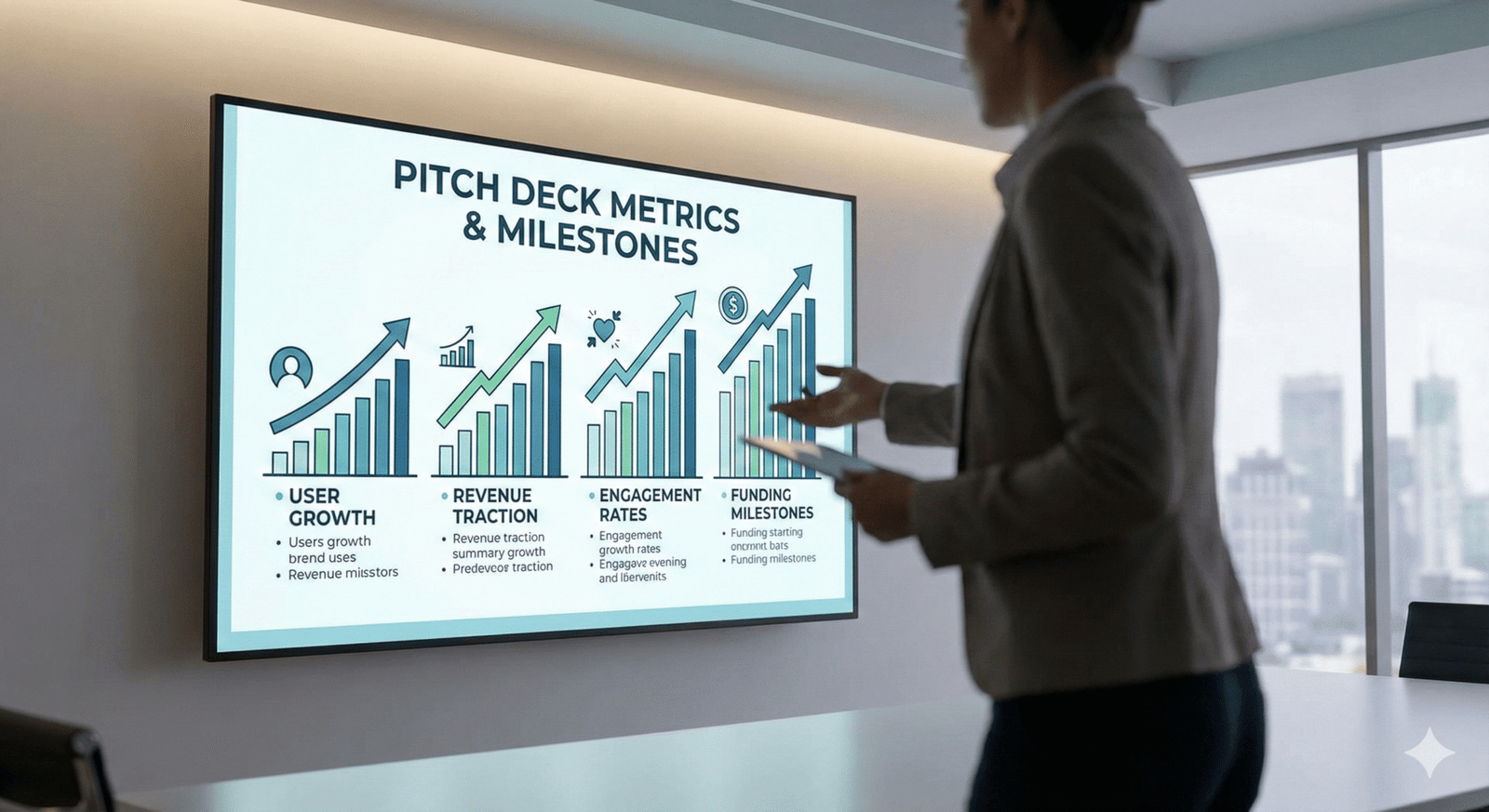
- Traction: Your best chart (ARR/GMV) with annotations.
- Unit Economics: CAC, LTV, payback; prove scale does not break the model.
- Milestones & Ask: What you have hit, what is next, and how this round gets you there.
Keep each slide laser-focused: one idea, one takeaway metric, one clear visual.
6) Visualizing Metrics So They Land in 3 Seconds
Use the right chart:
- Line: trends (MRR, GMV, users)
- Bar: comparisons (cohorts, channels, segments)
- Stacked Bars: revenue mix (new vs. expansion)
- Funnel: conversion (install → signup → paid)
- Cohort Heatmap: retention over time
Design rules investors love:
- Limit to two brand colours + neutral grey.
- Label exact values on peaks/inflections.
- Add context notes (“Pricing v2 in May”, “Launched v2 in Sep”).
- Avoid chart junk (no 3D, drop shadows, decorative gradients).
- Keep y-axes honest, do not crop to exaggerate growth.
7) The Milestones Slide: Past Proof, Future Confidence
Your milestones should reduce risk in the investor’s mind. Group by risk area:
- Team Risk: key hires, advisors, domain expertise
- Product Risk: prototype → MVP → v1.0 → v2.0, SLAs, security audits
- Market Risk: first 10/50/100 paying customers, by segment.
- GTM Risk: channel partnerships, reseller wins, PLG loops
- Regulatory Risk: certifications, approvals, compliance
- Funding Risk: non-dilutive grants, pre-orders, revenue-funded pilots
8-second format
- Left: Timeline (quarters)
- Centre: Past milestones (✅)
- Right: Next milestones (◇) + KPIs proving completion
Replace vague goals with measurable targets:
“Improve onboarding” → “Reduce time-to-value from 8 days → 48 hours; Week-1 activation 32% → 55%.”
8) Example: What a Great Traction Slide Looks Like (Text Version)
Title: Traction: Compounding ARR With Expanding Accounts
Visual: Line chart (ARR, monthly) + stacked bars (new vs. expansion)
Callouts:
- “Pricing v2 launched in May → Payback improved 14 → 9 months.”
- “Sales-assisted pilot motion cut cycle 78 → 41 days.”
- “Top 10% accounts expanding at 142% NRR.”
Footer Micro-metrics: CAC: $1,250 | LTV: $6,100 | Payback: 9 mo. | NRR: 128%
9) The Slide Order That Works (and why)
- Cover: Big promise, crisp tagline.
- Problem: Quantified pain
- Solution: How you remove the pain.
- Product (1–2): Screens, demo, before/after
- Market (1–2): Wedge → beachhead → expansion
- Traction (1–2): Growth chart + efficiency metric
- Business Model: Pricing, take rate, margins.
- Go-to-Market: Motion, channels, cycle.
- Unit Economics: CAC, LTV, payback, margins
- Milestones & Roadmap: Past proof + next KPIs
- Team: Why this team, this market, now
- Ask & Use of Funds: Round size, runway, hiring plan.
Keep it 12–14 slides; put detail in the appendix.
10) Storytelling That Sticks: From Numbers to Narrative
- Contrast: “Manual invoice matching 6 hours/week → 6 minutes with us.”
- Causality: Tie lifts to actions: “After in-app guides, activation 31% → 52%.”
- Credibility: Screenshots, quotes, mini case studies.
- Clarity: One headline takeaway per slide.
- Memory Hack: Pair every graph with a punchline:
“Expansion revenue now exceeds new, NRR at 128%.”
11) Common Mistakes (and Exactly How to Fix Them)
- Too many metrics. → Pick 3–7 total spanning growth, efficiency, durability.
- Stale or inconsistent data. → Date-stamp every chart; set a cutoff (“Data through Sep 2025”).
- Vanity metrics without linkage. → Tie them to economics (installs → activation → paid → ARPU).
- Charts without context. → Annotate inflection points with the action that caused them.
- No milestones or vague goals. → Make measurable next steps with timelines & KPIs.
- Hiding weaknesses. → Acknowledge risk; show the experiment running to fix it.
12) Cohort Analysis: Your Secret Weapon
One slide that separates pros from tourists: cohort retention by signup month.
Show: % of revenue (or users) retained over months 1–12.
Why it matters: Proves product-market fit (flat or improving decay) and expansion.
Pro tip: Add a mini table of Cohort LTV to spotlight improving unit economics.
Even with 6–8 months of data, a clean cohort trend wins credibility.
13) Unit Economics, Explained Simply (With Examples)
CAC (Customer Acquisition Cost)
If you spent $100k on S&M and acquired 80 new customers, CAC = $1,250.
LTV (Lifetime Value)
If ARPU = $180/month, Gross Margin = 75%, Average Lifetime = 24 months:
LTV = 180 × 0.75 × 24 = $3,240.
LTV:CAC
$3,240 ÷ $1,250 = 2.6:1 → Good; improve pricing or retention to pass 3:1.
Payback Period
If monthly gross profit per customer is $140 and CAC is $1,250:
Payback = 1,250 ÷ 140 ≈ 9 months → Strong at Seed/Series A.
14) Seed vs. Series A/B: What Changes?
Seed
- Emphasis: Insight + early traction
- Metrics: Activation, early retention, pilots, revenue ramp
- Milestones: MVP → paid → repeatable motion experiments
Series A
- Emphasis: Repeatability
- Metrics: NRR, CAC/payback, sales cycle, win rates, pipeline coverage
- Milestones: Scalable acquisition channel, hiring plan for predictability
Series B+
- Emphasis: Efficiency at scale
- Metrics: Rule of 40, contribution margin, cohort LTV, segment profitability
- Milestones: Category leadership, geographies, enterprise motion
15) “We Don’t Have Revenue Yet,” What to Show Instead
If you are pre-revenue, pivot to leading indicators:
- Activation rate (first key action within 7 days)
- Week-4 retention (% returning users)
- Waitlist → signup conversion.
- Time-to-value (onboarding speed)
- Sales pipeline (qualified pilots, $ value, cycle time)
- WTP surveys and price tests
- LOIs, design-partner agreements
Investors fund momentum and learning velocity. Show both.
16) Psychological Levers: Why Milestones Work
- Social Proof: Logos, testimonials, press build trust fast.
- Commitment/Consistency: A measured roadmap with deadlines signals discipline.
- Anchoring: Lead with your best metric; it frames the rest.
- Loss Aversion: Subtly show the cost of not investing (closing window, lagging competitors).
17) Real-World Patterns from Breakout Decks
- One killer traction graph front and centre.
- A clear economic story: “Each $1 in CAC returns $X in gross profit within Y months.”
- Expansion wins: NRR > 110% highlighted.
- Milestones that de-risk scale: “Fulfilment costs ↓38% after regional warehouse.”
- Ask grounded in math: “With $3.5M, we unlock 18 months runway at 10% MoM growth.”
18) Slide Copy You Can Steal (Swap in Your Numbers)
Slide Title: Efficient Growth with Expanding Accounts
Headline: NRR 124%; Payback 8 Months
Bullets:
- 14 consecutive months of MoM MRR growth (average 11.2%)
- CAC ↓27% after self-serve + PLG motion
- Top quartile cohort LTV ↑39% since pricing v2
Chart: Line (MRR), stacked bars (new vs. expansion)
Footer: CAC $1,050 | LTV $5,600 | GM 78% | Rule of 40 = 48
19) The KPI Roadmap: Turn Your Ask into a Plan
Example (12 months):
- Q1: Launch in-product onboarding → activation 34% → 55%.
- Q2: Add usage-based pricing → NRR > 115%.
- Q3: Channel pilot with 2 VARs → CAC ↓ 25%; Payback ≤ 8 mo.
- Q4: Mid-market motion; 3 enterprise references → ARR $3.2M
Use of Funds:
55% GTM (AE/SDR hires, paid + content engine)
30% Product (data infra, AI features, mobile parity)
15% Ops & Compliance (SOC 2 Type II, ISO 27001)
One-line promise: “This round gets us to $X ARR, Y months runway, and Series A readiness.”
20) Data Hygiene: Keep Trust High
- Only source of truth: lock a snapshot date (“Data through Sep 30”).
- Reconcile definitions: ensure CAC/LTV formulas are consistent.
- Show ranges: “Payback 7–10 months by segment.”
- Footnote anomalies: “One-off annual prepays in June; normalized ARR shown.”
21) Visual Templates (Text-Only Mock-ups)
Template A: ARR Trend + Expansion Mix
Left: Line graph (ARR, last 18 months)
Right: Stacked bars (New vs. Expansion vs. Reactivation)
Callouts: “Pricing v2 in May,” “Launched integrations in Aug,” “Sales cycle ↓45% in Oct”
Template B: Unit Economics Snapshot
2×2 grid cards: CAC, LTV, Payback, NRR
Each card: metric value + mini trend arrow + 1-line “what changed”
Template C: Retention Cohorts
Heatmap: month 0 → 12, % revenue retained
Footer: “Median cohort LTV $X; 4 cohorts >120% NRR by month 9”
Template D: Milestones Timeline
Horizontal timeline by quarter (rows: Product | GTM | Ops/Compliance)
Icons: ✅ completed, ◇ upcoming
Right panel: KPIs that mark completion.
22) The One-Slide Summary Investors Screenshot
Include at the end (or right after the cover):
- What we do: 1 sentence
- Why now: the shift making this inevitable
- Stage & scale: ARR/GMV + growth rate
- Economics: NRR, CAC, Payback
- Logos: 6–8 recognizable brands (with permission)
- Ask: $X for Y months runway to hit Z milestones
This is your forwardable snapshot for internal partner shares.
23) Frequently Asked Founder Questions
Q: Which metric goes on the title slide?
A: If you have got it, ARR with growth rate. If not, your best proof of pull (NRR, cohort retention, GMV growth, or breakout adoption).
Q: How many milestones should we show?
A: 5–8 total: 3–4 done (proof), 3–4 next (plan). More is noise.
Q: What if one metric is weak?
A: Acknowledge it and show the counter-balancing strength and the experiment:
“NRR is 101% today; pricing test v2 live to target 115% within two quarters.”
Q: Competitor slide approach?
A: Use a value pathway chart (time-to-value, automation depth, TCO) instead of crowded grids.
24) Keyword-Friendly Recap (for your deck notes)
Pitch deck metrics, startup milestones, MRR, ARR, CAC, LTV, payback, NRR, churn and retention cohorts, marketplace GMV & take rate, Rule of 40 and Magic Number, traction slide templates, visualize startup metrics, investor pitch deck examples.
25) Checklist: Before You Share the Deck
Content
- 12–14 slides, one takeaway each
- Clear traction chart (ARR/GMV) with annotated inflections
- Unit economics on one slide (CAC, LTV, payback, margin)
- Cohort/retention data if available
- Milestones: 3–4 done, 3–4 next with KPIs
- Ask & use of funds tied to metric improvements.
Design
- One headline per slide; subhead = so what
- Consistent typography & colour
- Labels on peaks/inflections
- No dense tables (move to appendix)
Data
- Snapshot date and consistent definitions.
- Remove vanity metrics unless connected to revenue/retention.
- Footnote anomalies and one-offs.
26) Copy-Paste Slides: Metrics & Milestones
Copy-Paste Slide: “Metrics That Matter”
ARR: $____ | MoM growth: ____%
NRR: ____% | Gross Margin: %
CAC: $ | Payback: ____ months
Churn (logo / revenue): __% / __%
Rule of 40: Growth __% + Margin __% = __
Takeaway (headline): “Efficient, compounding growth with expanding accounts.”
Copy-Paste Slide: “Milestones & What’s Next”
We have Achieved
✅ Shipped v2 with workflow automation; time-to-value ↓72%
✅ 50 paying customers; 6 enterprise pilots
✅ NRR 118%; self-serve conversion 5.1% → 8.3%.
Next 2 Quarters
◇ Launch usage-based pricing → NRR ≥ 125%
◇ Add partner marketplace → CAC ↓ 20%
◇ SOC 2 Type II; enterprise SSO.
Use of Funds
55% GTM | 30% Product | 15% Ops
27) Appendix: Handy Formulas
- ARR = MRR × 12
- Gross Margin % = (Revenue – COGS) ÷ Revenue × 100
- Logo Churn % (monthly) = Customers Lost ÷ Customers at Start × 100
- Revenue Churn % = MRR Lost ÷ MRR at Start × 100
- NRR % = (Start MRR – Churn + Expansion + Reactivation) ÷ Start MRR × 100
- CAC = Sales & Marketing Cost ÷ New Customers
- LTV (SaaS) = ARPU × Gross Margin % × Average Lifetime (months)
- Payback (months) = CAC ÷ Monthly Gross Profit per Customer
- Rule of 40 = Growth % + EBITDA Margin %
- Magic Number (SaaS) = (This Quarter’s New ARR × 4) ÷ Last Quarter’s S&M Spend
28) Bringing It All Together + Next Steps
A standout pitch does not bury investors in spreadsheets. It frames a few decisive metrics and milestones that prove demand, efficiency, and staying power, then ties your funding ask to a tight roadmap that measurably improves those metrics.
If you do nothing else, do this:
- Lead with a single, undeniable traction chart (ARR/GMV).
- Backstop it with unit economics (CAC, LTV, payback, margin).
- Show cohorts or NRR to prove durability.
- Close with milestones achieved and next KPIs—and a funding plan that gets you there.
One-Page Metrics & Milestones Summary (Printable)
What we do: __________________________
Why now: _____________________________
Traction
ARR/GMV: $________ | MoM Growth: ____%
NRR: ____% | Gross Margin: ____%
CAC: $____ | Payback: ____ months
Cohort Signal: Cohort Month ___ retains ___% at M+6.
Milestones
✅ Past: [3 bullets]
◇ Next: [3 bullets with KPIs]
Ask & Use of Funds
Raise $____ for ____ months runway
Allocation: __% GTM | __% Product | __% Ops
Target Outcomes: ARR $____ | NRR __% | Payback __ mo.
Summary: 5 Actionable Takeaways
- Choose 3–7 metrics across growth, efficiency, and durability; drop the rest.
- Tell the traction arc in 7 slides: hook → problem → solution → market → traction → unit economics → milestones & ask.
- Show 12–24 months of clean trends and annotate inflections with the action that caused them.
- Prove durability with NRR and cohort retention; aim for NRR ≥ 100% (120%+ is elite).
- Tie the raise to KPIs with a quarter-by-quarter roadmap and clear use of funds.
Unlocking the Secrets to Start
Unveil the secrets to beginning any venture with success. Practical tips and insights to ensure a powerful start.
Follow on LinkedInThank you for reading the article “Highlighting Key Metrics and Milestones“, Next article for “Secrets to Start“, Presenting to Potential Investors
Here is a quick glossary of every abbreviation/acronym used in the article:
A–C
- AE: Account Executive
- ARPU: Average Revenue Per User
- ARR: Annual Recurring Revenue
- CAC: Customer Acquisition Cost
- COGS: Cost of Goods Sold
- CPA: Cost Per Acquisition
D–G
- D1 / D7 / D30: Day-1 / Day-7 / Day-30 retention
- DAU: Daily Active Users
- EBITDA: Earnings Before Interest, Taxes, Depreciation, and Amortization
- GM: Gross Margin
- GMV: Gross Merchandise Value
- GTM: Go-To-Market
H–M
- ISO 27001: International Organization for Standardization 27001 (information security standard)
- KPI: Key Performance Indicator
- LTV: Lifetime Value (Customer Lifetime Value)
- MAU: Monthly Active Users
- MoM: Month over Month
- MRR: Monthly Recurring Revenue
N–S
- NRR: Net Revenue Retention
- PLG: Product-Led Growth
- SAM: Serviceable Available Market
- SDR: Sales Development Representative
- SLA: Service Level Agreement
- S&M (Spend): Sales & Marketing (spend)
- SOC 2: System and Organization Controls Type 2 (security/compliance audit)
- SOM: Serviceable Obtainable Market
- SSO: Single Sign-On
T–Z
- TAM: Total Addressable Market
- TCO: Total Cost of Ownership
- VAR / VARs: Value-Added Reseller / Resellers
- WTP: Willingness To Pay
- YoY: Year over Year
Combos & shorthand
- DAU/MAU: Daily Active Users to Monthly Active Users ratio (engagement stickiness)
- TAM/SAM/SOM: Market sizing trio (total / serviceable / obtainable)
- D1/D7/D30: Standard retention checkpoints at Day 1/7/30
Growth/virality term
- K-factor: Viral coefficient (how many new users each user brings)