
MSP Pricing: How to Build a Managed Services Contract Around Resource Units, AI Savings, and Real Usage
Managed services are supposed to simplify IT operations.
Yet many MSP pricing arrangements create the opposite result.
A company may outsource its service desk, infrastructure, workplace technology, applications, cloud operations, security, or even most of its IT estate. Over time, automation improves. AI handles repetitive work. The technology estate gets smaller. The supplier needs fewer people to deliver the same service.
But the monthly bill barely changes.
That is not primarily a technology problem. It is a commercial architecture problem.
Traditional managed services pricing models including cost-plus, per-user, per-device, fixed-fee, consumption-based, value-based, and outcome-based pricing, allocate risk differently. Industry research increasingly distinguishes traditional cost-oriented approaches from consumption, value, and outcome models, with usage-based pricing typically charging by metrics such as users, devices, transactions, or workloads.
For large enterprise outsourcing contracts, however, simply changing the name of the pricing model is not enough.
Calling something a “Resource Unit” does not automatically make it consumption-based.
A modern managed services contract needs a commercial system that determines:
- what constitutes a billable unit;
- who authorizes that unit;
- how consumption is measured;
- how fixed and variable costs are separated;
- what happens when demand rises or falls;
- how automation and AI savings reach the customer;
- how prices are benchmarked;
- how billing errors are detected;
- how service quality is protected; and
- whether another supplier can reproduce the calculation at exit.
Get those elements right and the contract behaves like a genuine consumption model.
Get them wrong and Resource Unit pricing can become time-and-materials billing with better branding.
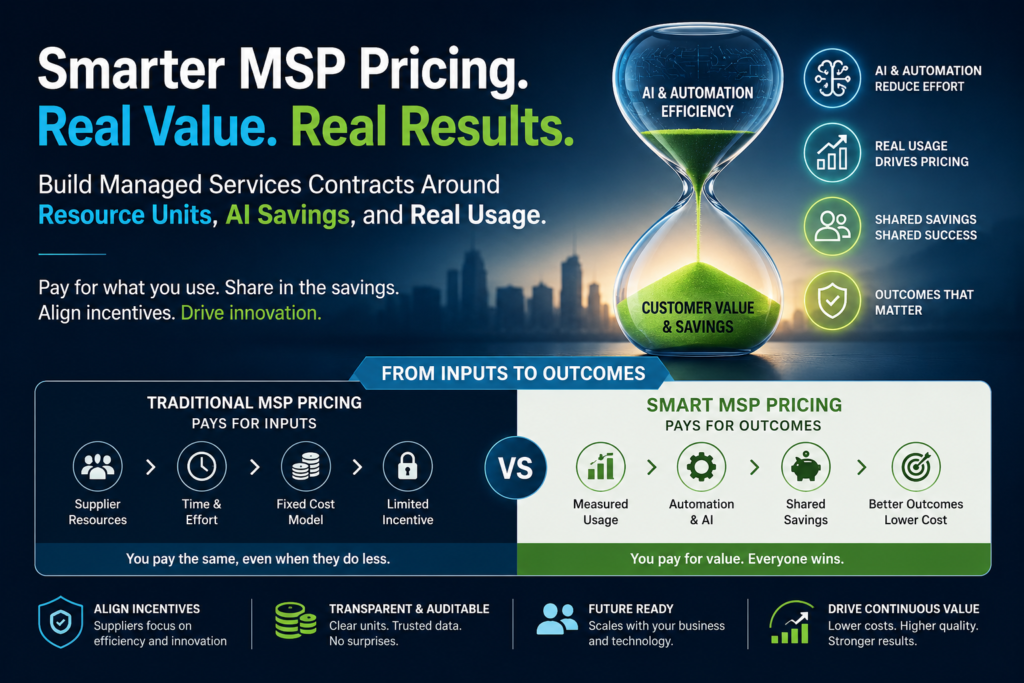
What Is MSP Pricing?
MSP pricing is the commercial mechanism used to determine what a customer pays a managed service provider for ongoing technology services.
Different MSP pricing models answer different questions.
An input-based model asks:
How much supplier effort is required?
A consumption-based model asks:
How much service did the customer consume?
An outcome-based model asks:
What result did the supplier achieve?
Those distinctions matter because the pricing mechanism helps determine who carries productivity, demand, inflation, and delivery risk.
Current UK sourcing guidance explicitly connects pricing design with risk allocation. It warns that poorly allocated risk can damage value for money and recognizes that cost-plus arrangements can weaken incentives for suppliers to maintain industry-standard productivity improvements.
That leads to the central principle of modern MSP pricing:
The customer should usually pay for measurable demand, consumption, or outcomes not for the supplier’s internal staffing model.
Why Traditional Managed Services Pricing Can Work Against the Customer
Consider a simple example.
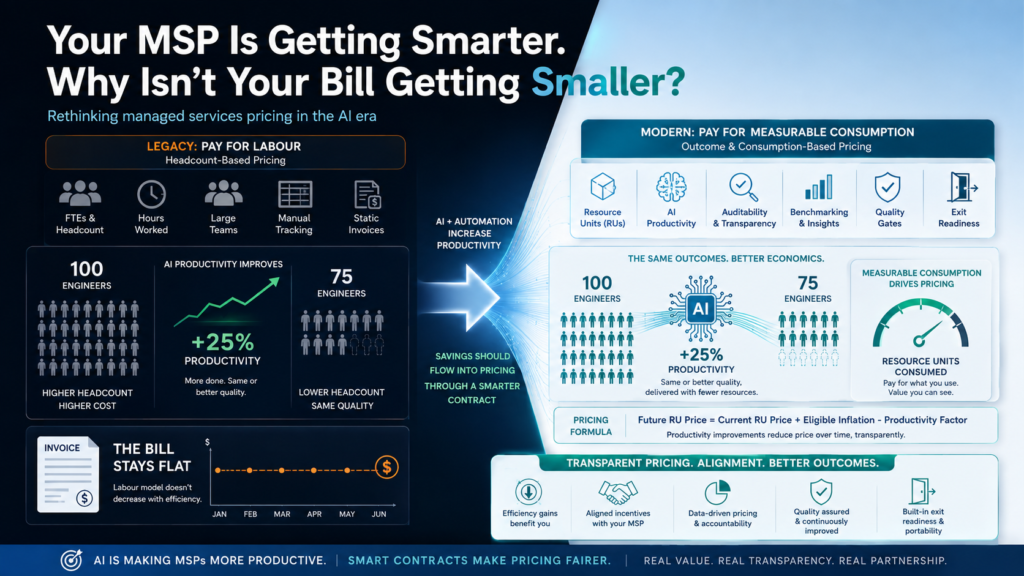
A supplier initially requires 100 employees to operate a managed service.
Two years later, better tooling, workflow automation, generative AI, and process redesign allow the same service levels to be achieved with 75 employees.
What happens to the customer price?
Under a pure FTE model, nothing necessarily happens.
The customer may still be buying the equivalent of 100 FTEs unless the contract requires headcount reductions, rebasing, or another commercial adjustment.
That creates an awkward incentive.
The supplier can increase its margin by becoming more efficient, while the customer continues paying according to an outdated delivery model.
A properly structured output or consumption model works differently.
The supplier remains free to decide whether it needs:
- 100 people;
- 75 people;
- offshore delivery;
- automation;
- AI agents;
- better monitoring;
- different workflows; or
- some combination of all of them.
The customer buys the service.
The supplier manages the production system.
That separation is one of the most important principles in IT outsourcing pricing.
What Is Resource Unit Pricing?
A Resource Unit (RU) is a defined, measurable unit used to calculate charges for a managed service.
A useful RU usually represents something the customer can independently identify or verify.
Examples include:
| Managed Service | Possible Resource Unit |
| Service desk | Supported user per month |
| End-user computing | Managed endpoint |
| Infrastructure | Managed server equivalent |
| Network operations | Managed network device |
| Application management | Weighted application |
| Security operations | Protected endpoint or asset |
| Cloud operations | Managed workload |
| Business-process outsourcing | Completed transaction |
Per-user, per-device, per-transaction, and per-workload pricing are established forms of consumption pricing in the managed services market.
The important question is not whether the contract uses the phrase “Resource Unit.”
It is what the Resource Unit actually measures.
The Golden Rule of Resource Unit Pricing: Do Not Price Supplier Inputs
An engineer-hour is measurable.
So is an FTE.
So is a technician-day.
But those units describe the supplier’s production inputs rather than the customer’s consumption.
Why FTE-Based Pricing Weakens Automation Incentives
Imagine that AI eliminates 25% of a repetitive operational workload.
With input-based pricing, the parties may immediately face uncomfortable questions:
Does the customer now remove 25% of the FTEs?
Does the supplier claim the resources are still required for resilience?
Is automation outside scope?
Does the supplier charge separately to implement the automation?
Does the customer need to raise a change request to benefit from the productivity improvement?
A good output-based MSP contract avoids much of this argument.
The supplier remains responsible for meeting the outcome at the agreed price.
How it does so is largely its problem.
Which Resource Units Work Best?
The right RU depends on the service.
For a service desk, supported users may be better than tickets. Ticket-based pricing can create a perverse incentive: if the supplier prevents incidents, its revenue falls.
For workplace services, managed endpoints are often objectively measurable.
For infrastructure, managed server or workload equivalents may make sense.
Application support may require weighted application units because supporting a low-risk internal reporting application is not economically equivalent to supporting a highly regulated, 24/7 critical system.
Transactions can work well in business-process environments, provided the supplier cannot generate unnecessary transactions.
Outcome-based units can create excellent alignment, but only where outcomes can be objectively attributed and measured.
When a Hybrid MSP Pricing Model Is Better
Not every managed services cost changes immediately when consumption changes.
A supplier may have unavoidable fixed costs for:
- governance;
- monitoring platforms;
- service-management tooling;
- dedicated infrastructure;
- transition investment; or
- minimum operational coverage.
Pretending that every cost is variable usually leads to hidden commercial protection elsewhere.
A cleaner structure is often:
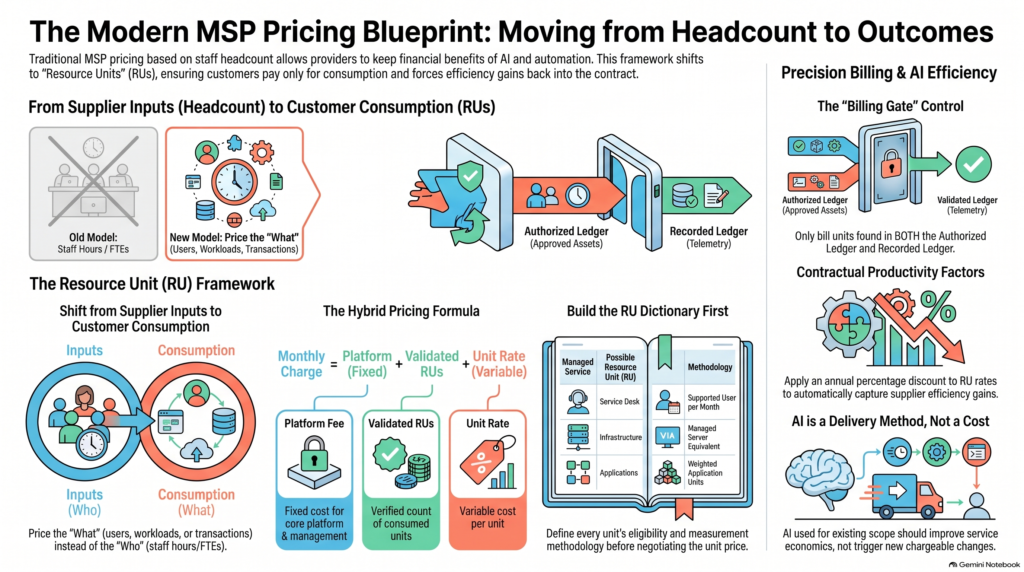
Monthly Charge = Platform Fee + Validated Resource Units × Unit Rate − Service Credits
The platform fee covers demonstrably fixed costs.
The RU rate covers variable consumption.
The distinction matters because it makes supplier economics visible.
If fixed costs eventually disappear, the fixed charge should be capable of falling with them.
Build a Resource Unit Dictionary Before Negotiating Rates
One of the biggest MSP pricing mistakes is negotiating the price before agreeing what is being priced.
That is like agreeing to pay $5 per “container” before determining whether the container is a cup or a tanker.
Create a Resource Unit Dictionary first.
What Every Resource Unit Definition Should Contain
Each RU should ideally define:
- a permanent RU code;
- business definition;
- included services;
- exclusions;
- eligibility criteria;
- source system;
- measurement methodology;
- measurement period;
- activation rules;
- deactivation rules;
- treatment of duplicates;
- geography;
- complexity classification;
- weighting methodology;
- baseline quantity;
- volume bands;
- rate bands;
- relationship with SLAs; and
- meter-rule version.
This definition becomes part of the commercial control environment.
Without it, invoice disputes become arguments over interpretation rather than evidence.
Keep Complexity Weighting Objective
Weighted Resource Units are sometimes necessary.
Suppose applications are classified:
- Standard: 1.0 RU
- Complex: 1.5 RU
- Critical: 2.5 RU
That seems straightforward until someone controls the classification.
If the supplier can unilaterally move applications from “standard” to “critical,” complexity becomes a revenue lever.
Classification therefore needs objective characteristics.
These might include:
- support hours;
- transaction criticality;
- regulatory requirements;
- resilience tier;
- technology stack;
- integration count;
- user population; and
- recovery requirements.
The mapping should be version-controlled and changed only through an agreed governance process.
Separate Technical Consumption From Commercial Consumption
One of the most useful ideas in modern technology billing comes from the FinOps Open Cost and Usage Specification, or FOCUS.
FOCUS standardizes technology billing data. Its latest 1.4 release, ratified in June 2026, expands support for areas including invoice reconciliation and contract commitments.
The broader lesson for MSP contracts is important:
The thing your technology measures does not necessarily have to be the thing your contract prices.
A monitoring platform may record millions of technical events.
The managed services contract might transform those records into 10,000 monthly workload RUs.
That is perfectly reasonable provided the transformation logic is transparent and reproducible.
Do not make every technical event an invoice line.
Define the conversion from technical consumption to commercial consumption.
Pool Resource Units Only When Their Economics Are Comparable
Pooling can simplify an MSP contract.
Imagine 40,000 broadly similar laptops distributed across multiple countries.
A single global endpoint pool may be easier to operate commercially than 30 separate local billing populations.
But pooling can become dangerous when units share a label but not an economic profile.
A highly regulated production application should not necessarily be pooled with a simple internal reporting tool simply because both are applications.
A practical test is:
Would another competent supplier expect roughly similar marginal delivery economics for these units?
If yes, pooling may make sense.
If not, separate them.
Capacity Corridors Are Not the Same as Purchase Commitments
Suppliers need reasonable demand forecasts.
That does not mean forecasts should automatically become guaranteed purchases.
Suppose the baseline is 100,000 supported units.
The supplier may agree to support a corridor from 80,000 to 120,000 units without changes to normal service levels.
That is an operational commitment by the supplier.
It should not automatically mean the customer guarantees payment for 100,000 units regardless of actual usage.
This distinction is critical.
Otherwise “flexible consumption pricing” quietly becomes take-or-pay pricing.
Baselines Should Support Planning Not Become Permanent Revenue Guarantees
Most enterprise outsourcing deals require an initial baseline.
The baseline is useful for:
- supplier planning;
- rate negotiations;
- capacity design;
- transition;
- budgeting; and
- benchmarking.
But baseline volume and billable volume do not have to be identical.
Model 1: Bill Actual Validated Resource Units
Where consumption data is mature, the cleanest structure is:
Monthly Charge = Fixed Platform Fee + Actual Validated RUs × Applicable Rate
If consumption falls, the variable charge falls.
If it rises, the charge rises.
That is genuine consumption-based pricing.
Model 2: Baseline Plus Volume Adjustments
Another model starts with baseline pricing and adjusts charges for movement above or below the baseline.
Conceptually:
Charge = Baseline Charge + Additional Usage Charge − Under-Consumption Credit
This can work, but the symmetry matters.
Suppose the customer pays $10 for each baseline RU.
Extra RUs also cost $10.
Yet when consumption falls, each missing RU produces only a $3 credit.
The supplier has effectively preserved $7 of revenue.
That may be appropriate if $7 genuinely represents unavoidable cost.
If not, it is simply hidden baseline protection.
Be Careful With Deadbands
A deadband creates an area around baseline volume in which charges do not change.
For example:
Baseline = 100,000 units
Lower adjustment point = 90,000 units
If consumption falls from 100,000 to 91,000, the customer pays the same amount.
That means a 9% reduction in demand creates zero commercial benefit.
Deadbands can make sense where small movements cannot economically be absorbed, but they should not become an excuse for suppressing normal consumption savings.
The Most Important Billing Control: Authorized Units vs. Recorded Units
This is one of the most powerful controls available in a Resource Unit model.
Create two separate ledgers.
Authorized Units Ledger
The Authorized Units Ledger (AUL) contains assets, users, applications, workloads, or transactions that the customer has approved as commercially eligible.
Recorded Units Ledger
The Recorded Units Ledger (RUL) contains what supplier systems actually detected.
These two populations should not automatically be treated as identical.
The Resource Unit Billing Gate
The commercial rule becomes:
Validated RUs = Recorded Units ∩ Authorized Units ∩ Approved Meter Rules
Only validated RUs reach the invoice.
Why is this important?
Suppose monitoring software detects a server that should have been retired four months ago.
Technically, the server exists.
Commercially, however, the customer may already have withdrawn authorization.
Supplier telemetry proves existence.
It does not automatically prove billability.
That difference can prevent significant invoice leakage.
Build the RU Meter Like a Financial Control System
A Resource Unit meter should not be an editable spreadsheet maintained solely by the supplier’s billing department.
Treat it like a financial subsystem.
Every billable event should ideally have enough evidence to answer:
- What resource generated the charge?
- Who authorized it?
- When was it active?
- Which source system detected it?
- Which rule classified it?
- Which pricing version applied?
- Was it duplicated?
- Was it corrected?
- Which invoice contains it?
The customer should be able to reproduce the invoice from underlying evidence.
Protect Billing Evidence From Undetected Changes
NIST’s AU-9 security control calls for audit information and audit logging tools to be protected against unauthorized access, modification, and deletion.
That principle translates well to commercial metering.
Useful controls include:
- append-only records;
- controlled administrative rights;
- non-destructive corrections;
- immutable source identifiers;
- independent timestamps;
- rule-version history;
- segregation between meter administration and invoice approval; and
- customer-accessible evidence exports.
The goal is simple:
No one should be able to alter the commercial history invisibly.
Prevent MSP Invoice Leakage Before It Reaches Accounts Payable
Most invoice leakage does not begin with bad multiplication.
It begins earlier in the data chain.
Common examples include:
- terminated users remaining billable;
- decommissioned devices remaining active;
- duplicate events;
- retroactive complexity changes;
- unauthorized meter-rule changes;
- wrong geographies;
- incorrect price bands;
- missing deactivation records;
- unsupported late charges; and
- new services being quietly mapped to existing RUs.
The contract should specify what happens when each control fails.
For example:
Unauthorized unit? Quarantine it.
Duplicate record? Reject it.
Unapproved meter-rule change? Use the last approved version.
Unproven complexity classification? Apply the lower class until evidence is supplied.
Late billing evidence? Time-bar it after an agreed period unless the customer caused the delay.
Do not rely on a generic invoice-dispute clause to solve every problem.
Design the controls upstream.
Use Shadow Billing Before the MSP Pricing Model Goes Live
The first production invoice should never be the first serious test of the meter.
A better implementation has four stages.
1. Discovery
Analyze enough historical consumption to understand:
- seasonality;
- growth;
- retirement patterns;
- acquisitions;
- known data gaps;
- duplicated records; and
- exceptional events.
2. Shadow Metering
Run the new meter without financial consequences.
Compare supplier calculations with customer calculations.
This is when you want to discover that the CMDB contains thousands of stale records not after invoices begin.
3. Baseline Manifest
Freeze a baseline showing the applicable:
- units;
- source systems;
- classifications;
- geographies;
- pricing categories; and
- meter rules.
Version the manifest.
4. Finite True-Up
Allow a clearly defined stabilization period.
Then close it.
An initial baseline should not remain permanently negotiable every time supplier economics disappoint.
UK sourcing guidance similarly emphasizes the value of reliable asset data and transparent mechanisms for handling material inaccuracies rather than leaving risks undefined.
Reconcile Usage Before the Invoice Is Issued
A strong monthly process follows three steps:
Validate. Price. Invoice.
Not:
Invoice. Dispute. Reconcile.
For example:
| Timing | Activity |
| D+1 | Consumption period closes |
| D+3 | Supplier submits evidence |
| D+5 | Automated reconciliation |
| D+7 | Customer exceptions returned |
| D+9 | Supplier evidence completed |
| D+10 | Validated RU ledger locked |
| D+11 | Pricing applied |
| D+12 | Invoice produced |
| D+15 | Approval or formal dispute |
The dates can change.
The sequencing should not.
Benchmarking Should Correct Prices, Not Just Generate Reports
Long-term IT outsourcing has a structural problem:
Technology economics change faster than long-term contracts.
A competitive MSP price in year one may become expensive by year four.
Automation improves.
AI becomes mainstream.
Tools consolidate.
Infrastructure gets cheaper.
Delivery models change.
Skills become more productive.
This is why benchmarking should not merely inform the governance committee that prices are high.
It should be capable of correcting the economics.
Build the Benchmark Pack When the Contract Is Signed
A future benchmark cannot compare deals intelligently using only “price per user.”
Record the commercial context from day one:
- RU definitions;
- RU weighting;
- normalized volumes;
- rates;
- service levels;
- coverage hours;
- service locations;
- technology stack;
- security obligations;
- automation maturity;
- fixed fees;
- bundled tooling;
- regulatory obligations; and
- transition assumptions.
Otherwise comparisons become meaningless.
Benchmark the Whole Commercial Package
Do not benchmark only the attractive headline rate.
Include:
- platform fees;
- normal RU rates;
- surge rates;
- under-consumption credits;
- software charges;
- mandatory tooling;
- pass-through costs; and
- recurring retained fees.
A supplier should not be able to lower one visible rate while recovering the difference elsewhere.
How Should AI Savings Affect MSP Pricing?
AI creates a particularly important outsourcing question:
Who owns the productivity benefit?
Suppose generative AI allows the supplier to complete work faster while meeting exactly the same contracted requirements.
Has customer scope changed?
Usually, no.
Has the service outcome changed?
No.
The supplier has changed its production method.
Therefore, a useful contractual default is:
AI used to perform already-contracted work is normally a delivery method not automatically a chargeable scope change.
Do Not Put a Universal “AI Discount” in the Contract
AI productivity varies dramatically by task and operating environment.
A large study of 5,172 customer-support agents found that access to generative AI increased issues resolved per hour by about 15% on average, with materially different effects across worker groups.
A controlled GitHub Copilot experiment found participants with Copilot completed a specific programming task 55.8% faster. That is meaningful evidence for that experiment but it is not evidence that every application-management contract should suddenly cost 55.8% less.
DORA’s more recent research makes the same broader point from another direction: AI can amplify strong systems, but individual productivity gains can be lost in downstream testing, security, deployment, and organizational bottlenecks.
So avoid clauses such as:
“AI will produce a 30% saving.”
A stronger principle is:
“Verified productivity improvements must improve service economics while agreed quality and risk controls remain intact.”
Add a Contractual Productivity Factor to MSP Pricing
One of the simplest ways to make efficiency visible is an annual productivity factor.
For example:
Future RU Rate = Current RU Rate × (1 + Eligible Indexation − Productivity Factor)
Assume:
Eligible inflation = 3%
Annual productivity factor = 5%
The net price movement is approximately negative 2%, subject to the precise formula and compounding method.
This creates a commercial expectation that mature services should become more efficient.
The customer does not need to negotiate every automation initiative separately.
And the supplier remains free to decide how it achieves the productivity commitment.
Separate Inflation From Supplier Productivity
Automatically indexing 100% of an MSP contract to consumer inflation can undermine the commercial model.
Managed services contain different cost drivers:
- local labor;
- offshore labor;
- software;
- infrastructure;
- energy;
- third-party licences;
- facilities;
- automation; and
- supplier margin.
Those components do not necessarily move together.
UK sourcing guidance recommends choosing indices that reflect relevant cost lines and notes that cost-plus structures can reduce incentives to capture normal productivity improvements.
A more disciplined formula is:
New Price = Old Price × [1 + Weighted Eligible Inflation − Contractual Productivity]
Do not automatically provide inflation protection to portions of the economics that should be benefiting from efficiency.
Use Gainshare for Truly Incremental AI and Automation
The productivity factor should cover normal continuous improvement.
But sometimes a supplier proposes something genuinely incremental.
Perhaps it wants to invest heavily in a new automation platform.
Perhaps the implementation has material risk.
Perhaps the project needs customer funding.
A gainshare can make sense.
A Better AI Gainshare Waterfall
First, establish normalized pre-change economics.
Second, measure post-change economics.
Third, deduct agreed incremental implementation investment.
Fourth, confirm that quality thresholds have been maintained.
What remains is verified net savings.
Only verified net savings should be shared.
If the customer paid for the implementation, the customer should generally capture most of the benefit.
If the supplier funded a risky investment, it may receive a larger temporary share until that investment has been recovered.
Prevent Double Counting of AI Savings
This is critical.
Assume an automation initiative creates $2 million in annual savings.
The supplier receives gainshare.
Then the annual productivity factor also incorporates the same improvement.
Then a benchmark lowers the market price because competitors now use the same automation.
Without careful drafting, the same saving can be counted multiple times.
A clear contractual waterfall might be:
- Determine validated RU volume.
- Apply applicable RU rates.
- Apply permitted indexation.
- Apply the normal productivity factor.
- Apply separately approved incremental gainshare.
- Apply service credits.
- Apply benchmark resets.
Once an innovation becomes standard market practice, the customer should not pay an innovation premium indefinitely.
AI Productivity Must Pass Quality Gates
Efficiency without quality is not productivity.
A service desk can improve “tickets closed per employee” by closing tickets prematurely.
A software team can increase code output while defects rise.
A chatbot can increase automated resolution simply by making it harder for users to reach humans.
Therefore, AI-related productivity should be subject to quality gates.
Possible measures include:
- SLA compliance;
- first-contact resolution;
- ticket reopen rate;
- mean time to restore;
- customer satisfaction;
- defect escape rate;
- rework;
- change failure;
- security incidents;
- availability; and
- regulatory findings.
Only savings achieved without unacceptable deterioration should qualify as productivity gains.
Keep SLAs Intact Within Normal Volume Corridors
Suppose the supplier agreed to support between 80% and 120% of forecast demand.
Baseline usage is 100.
Demand reaches 115.
The supplier should not suddenly claim that normal SLAs are suspended because volume increased.
Supporting normal variation is the purpose of the capacity corridor.
Where extraordinary volumes genuinely create additional cost or operational risk, define the mechanism in advance.
Use:
- surge bands;
- pre-priced overages;
- notice requirements; or
- agreed extraordinary-event procedures.
Do not improvise commercial rules after demand has already changed.
Allocate MSP Contract Risk to the Party That Controls It
A sophisticated contract does not push every conceivable risk to the supplier.
That merely encourages suppliers to price risk premiums.
Instead, allocate risk according to control.
The supplier normally controls:
- staffing;
- delivery pyramid;
- utilization;
- workflow design;
- automation;
- tooling;
- scheduling; and
- ordinary delivery productivity.
The customer normally controls:
- genuine changes in scope;
- business decisions that create demand;
- acquisitions and divestitures; and
- certain policy or strategy decisions.
External economic shocks may require shared mechanisms.
The pricing architecture should reflect those realities.
Put AI Governance Into the Managed Services Contract
AI cannot be treated purely as an efficiency tool.
If an MSP uses generative AI, machine learning, or autonomous agents in service delivery, the contract should address:
- permitted AI uses;
- prohibited uses;
- customer-data access;
- prompt handling;
- model training;
- generated code;
- human oversight;
- security;
- intellectual property;
- incident reporting;
- model changes; and
- regulatory responsibilities.
The EU AI Act uses a risk-based regulatory structure. High-risk systems are subject to requirements involving areas such as risk management, documentation, traceability, human oversight, accuracy, cybersecurity, and robustness.
A particularly important contractual rule is:
Customer operational data should not automatically become supplier model-training data simply because AI was introduced into the delivery process.
Make the permission explicit.
Treat RU Billing Data as Sensitive Operational Data
The commercial ledger may contain far more than finance data.
Depending on the RU design, it could include:
- user identifiers;
- endpoint IDs;
- locations;
- workload information;
- application records;
- timestamps;
- transaction information; and
- security telemetry.
That means the meter belongs inside the organization’s data-protection and security architecture.
Billing evidence should have retention rules, access controls, integrity controls, and clear ownership.
The pricing engine may determine invoices, but the underlying information is still operational data.
Make Exit Reproducibility a Contract Requirement
A customer can “own the data” and still be effectively locked in.
Why?
Because only the incumbent understands:
- RU mappings;
- meter logic;
- authorization history;
- complexity rules;
- scripts;
- automation;
- exceptions; and
- reconciliation processes.
A strong exit clause solves this differently.
The successor supplier should receive enough information to reproduce historical calculations.
The exit package should include:
- RU dictionary;
- baseline manifests;
- authorization histories;
- consumption history;
- source mappings;
- rule versions;
- calculation logic;
- test cases;
- pricing rules;
- reconciliation records;
- automation inventory;
- relevant operating procedures; and
- performance history.
For EU financial entities within DORA’s scope, third-party ICT risk rules specifically contemplate contractual controls and dedicated exit strategies that enable transition to another provider or an alternative operating model.
A useful exit test is therefore:
Can a qualified third party rerun an earlier billing period and obtain substantially the same result?
If not, the commercial system is still supplier-dependent.
Build Governance Around Checks and Balances
Do not allow one party to control every stage of the billing chain.
The supplier should not simultaneously:
define the RU, authorize the RU, generate the telemetry, change the meter rules, approve exceptions, calculate the invoice, and certify the invoice as correct.
Separate responsibilities.
A healthier model is:
Customer: controls commercial authorization.
Supplier: produces operational evidence.
Joint governance: approves rule changes.
Billing engine: applies version-controlled rules.
Finance: invoices from the locked validated ledger.
Independent benchmarker: tests market competitiveness.
Audit: can inspect the underlying evidence.
At the same time, avoid micromanaging the supplier’s internal staffing.
If the customer specifies every role, location, shift, and headcount, it begins taking back the delivery responsibility it supposedly outsourced.
Govern outputs, economics, controls, and quality.
Let the supplier manage ordinary production inputs.
Track KPIs That Reveal Commercial Drift
Traditional MSP dashboards often tell you whether incidents were resolved on time.
They rarely tell you whether the commercial model is still working.
Add metrics such as:
- RU cost trend;
- invoice accuracy;
- exception rate;
- unauthorized-unit rate;
- duplicate-event rate;
- consumption versus baseline;
- benchmark variance;
- automation savings;
- productivity-factor achievement;
- quality-gate performance;
- rule-change compliance;
- customer reconciliation time; and
- exit-data completeness.
Labor per RU can be useful as an open-book diagnostic.
But do not accidentally convert it back into the charging mechanism.
MSP Pricing Negotiation Checklist
Before signing a Resource Unit-based managed services contract, test the model against these questions:
- Does each RU represent measurable customer demand, consumption, or output?
- Can the supplier automate work without requiring the customer to approve staffing reductions?
- Does lower customer consumption normally reduce variable charges?
- Are genuine fixed costs separately visible?
- Is every RU contractually defined?
- Is the measurement system specified?
- Can every billed RU be tied to customer authorization?
- Are meter algorithms version-controlled?
- Can the customer reproduce the invoice?
- Are duplicate and unauthorized units automatically rejected?
- Is the baseline frozen after a finite stabilization period?
- Do SLAs continue throughout the normal capacity corridor?
- Are over-consumption rates agreed in advance?
- Are under-consumption economics transparent?
- Is annual productivity improvement contractually expected?
- Is indexation limited to appropriate cost components?
- Can benchmarking result in real price corrections?
- Does the benchmark examine the entire economic package?
- Are AI savings verified rather than guessed?
- Are AI savings subject to quality gates?
- Is double counting prohibited?
- Are AI training and customer-data rights explicit?
- Can auditors review underlying billing evidence?
- Do repeated billing failures trigger escalating remedies?
- Can a successor reproduce the RU calculation at exit?
If several answers are “no,” the contract probably does not contain a mature consumption model.
It contains a pricing schedule.
Those are not the same thing.
Frequently Asked Questions About MSP Pricing
What is the best MSP pricing model?
There is no single best model for every service.
For standardized, measurable services, consumption-based pricing using users, devices, workloads, or other Resource Units often provides strong transparency.
Outcome-based pricing can create even stronger alignment where outcomes are objectively measurable, but it requires better data and clearer attribution.
Hybrid models are often practical when the service contains both genuine fixed costs and variable consumption.
What is Resource Unit pricing in IT outsourcing?
Resource Unit pricing calculates managed services charges using a contractually defined unit such as a supported user, managed endpoint, server equivalent, application, or workload.
A mature RU model defines not only the unit price but also the eligibility, authorization, measurement, reconciliation, and audit rules behind the unit.
Should MSP pricing fall when AI improves productivity?
Not automatically by an arbitrary percentage.
Instead, the contract should contain mechanisms such as declining unit economics, contractual productivity factors, benchmarking, or verified gainshare that convert sustainable productivity improvements into better customer economics without reducing agreed service quality.
Should an MSP charge separately for AI?
It depends on what changed.
If the supplier uses AI internally to perform work already included in scope, AI is usually better viewed as a delivery method.
If the customer asks for a new AI-enabled capability, new software, additional scope, or a separately funded transformation project, additional charges may be justified.
What is consumption-based pricing for managed services?
Consumption-based pricing means charges move according to a defined measure of actual usage.
Examples include price per user, device, workload, transaction, application, or another objectively measurable unit.
For the model to work properly, the contract also needs reliable metering and controls over which observed units are commercially authorized.
Final Takeaway: Modern MSP Pricing Should Make Productivity Visible
The most important idea in modern MSP pricing is simple:
Customers should pay for the service they consume or the outcome they receive. Suppliers should manage how efficiently they produce it.
Everything else supports that principle.
Resource Units define what is being bought.
The Authorized Units Ledger determines what is commercially eligible.
The Recorded Units Ledger shows what supplier systems detected.
The validation process determines what is billable.
The pricing schedule converts validated demand into charges.
The productivity factor forces efficiency into the price path.
AI gainshare rewards genuinely incremental innovation.
Benchmarking keeps long-term prices connected to the external market.
Quality gates prevent false productivity.
Audit controls reduce billing leakage.
Exit provisions prevent commercial lock-in.
AI makes this architecture more important, not less.
The evidence already shows why. AI productivity gains can be significant, but they vary substantially by task, worker, workflow, and surrounding operating system.
The strongest managed services contract therefore does not rely on a heroic prediction that “AI will save 30%.”
It does something more durable:
It creates a mechanism through which verified efficiency automatically improves customer economics while quality, security, and accountability remain protected.
That is the difference between an MSP contract that merely buys outsourced labor and one that buys a continuously improving managed service.

Summary: Five Actions to Improve Your MSP Pricing Model
1. Replace supplier inputs with customer-observable units.
Use users, devices, workloads, applications, transactions, or measurable outputs wherever practical rather than FTEs and hours.
2. Separate authorization from telemetry.
Do not let supplier monitoring data automatically become an invoice. Reconcile recorded consumption against customer-approved units.
3. Make productivity contractual.
Use efficiency factors, benchmark resets, and carefully designed gainshare so automation and AI can improve the customer’s economics.
4. Protect quality and auditability.
No productivity saving should depend on worse SLAs, weaker security, higher rework, or a billing engine only the supplier can understand.
5. Design the contract for exit from day one.
A successor supplier should be able to understand the Resource Unit definitions, reproduce historical calculations, and operate the commercial meter independently.
If you are reviewing or renegotiating a managed services agreement, start with the Resource Unit Dictionary and billing architecture before negotiating the headline rate. A cheap unit price attached to a weak meter can ultimately cost far more than a well-controlled pricing model.
Get in touch with us
Unlocking the “Secrets to Start“
Unveil the secrets to beginning any venture with success. Practical tips and insights to ensure a powerful start.
Follow on LinkedInThanks for reading the article “MSP Pricing: Resource Units, AI Savings & Risk” and read article on Digital Marketing for Leaders and to read all articles on Business Startups