
Verses, Meanings, Symbols, and a Practical Guide to “Om Namaḥ Śivāya”
What Is the Shiva Pañchākṣarī?
Pañcha = five. Akṣara = syllable.
The Pañchākṣarī Stotram celebrates Na–Ma–Śi–Va–Ya the five seed sounds that culminate in the living mantra ॐ नमः शिवाय (Om Namaḥ Śivāya). Each syllable praises a facet of Shiva and trains a facet of you: body, emotion, will, heart, and speech.
Mantra: ॐ नमः शिवाय (Om Namaḥ Śivāya)
Five steps: Na ego settles (witnessing) → Ma emotions purify (cool clarity) → Śi pain transforms (burns patterns) → Va heart opens (balanced wisdom) → Ya truth expresses (pure presence).
Symbols to remember: serpent-neck (awareness), ash (impermanence), third eye (insight), triśūla (time & inner powers), ḍamaru (vibration), Nīlakaṇṭha (contain poison).
Daily rhythm: dawn/dusk; 108 reps; steady breath; sit 1 min in silence.
Essence: Not me but Śiva. Awareness becomes your nature.
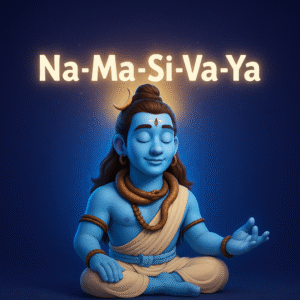
Verse 1 Na
Devanāgarī:
नागेन्द्रहाराय त्रिलोचनाय
भस्माङ्गरागाय महेश्वराय
नित्याय शुद्धाय दिगम्बराय
तस्मै न काराय नमः शिवाय
Nāgendrahārāya trilocanāya | bhasmāṅgarāgāya Maheśvarāya | nityāya śuddhāya digambarāya | tasmai na-kārāya namaḥ śivāya ||
Verse 2 Ma
Devanāgarī:
मन्दाकिनि सलिल चन्दनचार्चिताय
नन्दीश्वर प्रमथनाथ महेश्वराय
मन्दार पुष्प बहुपुष्प सुपूजिताय
तस्मै म काराय नमः शिवाय
Mandākinī-salila-candana-cārcitāya | Nandīśvara-pramathanātha-Maheśvarāya | Mandāra-puṣpa-bahupuṣpa-supūjitāya | tasmai ma-kārāya namaḥ śivāya ||
Verse 3 Śi
Devanāgarī:
शिवाय गौरी वदनाब्जवृन्द सूर्याय
दक्षाध्वर नाशकाय
श्री नीलकण्ठाय वृषध्वजाय
तस्मै शि काराय नमः शिवाय
Śivāya Gaurī-vadanābjavṛnda-sūryāya | Dakṣādhvara-nāśakāya | Śrī-Nīlakaṇṭhāya Vṛṣadhvajāya | tasmai śi-kārāya namaḥ śivāya ||
Verse 4 Va
Devanāgarī:
वशिष्ठ कुम्भोद्भव गौतमार्य
मुनिन्द्र देवर्चित शेखराय
चन्द्रार्क वैश्वानर लोचनाय
तस्मै व काराय नमः शिवाय
Vaśiṣṭha-kumbhodbhava-Gautamārya- | munīndra-devārcita-śekharāya | candrārka-vaiśvānara-locanāya | tasmai va-kārāya namaḥ śivāya ||
Verse 5 Ya
Devanāgarī:
यक्ष स्वरूपाय जटाधराय
पिनाकहस्ताय सनातनाय
दिव्याय देवाय दिगम्बराय
तस्मै य काराय नमः शिवाय
Yakṣa-svarūpāya jaṭādharāya | Pināka-hastāya sanātanāya | divyāya devāya digambarāya | tasmai ya-kārāya namaḥ śivāya ||
Essence in One Breath
Form: ash-smeared, serpent-ornamented, matted hair
Power: three eyes, time-transcending, destroyer of ego
Compassion: Nīlakaṇṭha absorbs poison so others live
Relationship: beloved of devotees, sages, and the gaṇas
State: detached, eternal, all-pervading
Five syllables: Na • Ma • Śi • Va • Ya → ॐ नमः शिवाय
The Esoteric Map: What Each Syllable Trains in You
| Verse | Syllable | Inner Work | Key Symbols | What It Trains |
| 1 | Na | Ego dissolves | Serpent, ash, sky-clad | Detachment, witness-mind |
| 2 | Ma | Emotions purify | Gaṅgā, sandal, flowers | Cool mind, virtues |
| 3 | Śi | Pain transforms | Nīlakaṇṭha, Dakṣa-yajña | Hold poison, break patterns |
| 4 | Va | Wisdom awakens | Moon–Sun–Fire eyes | Balance mind–soul–will |
| 5 | Ya | Liberation stabilizes | Yakṣa, Pināka, sky-clad | Mastery, pure presence |
Mnemonic: Na-Ma = “not me,” Śi-Va-Ya = “but Śiva (within).”
Chakra Threading (Subtle Physiology for Practice)
- Na → Mūlādhāra (Earth): stability; fear softens; the body-identity loosens.
- Ma → Svādhiṣṭhāna (Water): emotions cool & flow; creativity revives.
- Śi → Maṇipūra (Fire): habit loops / anger transmute to courage & clarity.
- Va → Anāhata (Air): resentment loosens; compassion becomes natural.
- Ya → Viśuddhi (Ether): speech purifies; truth-telling without ego.
Then Ajñā and Sahasrāra often bloom on their own.
Five Syllables, Five Layers (Element • Chakra • Dissolves • Gift)
| Syllable | Element | Chakra | Dissolves | Gift |
| Na | Earth | Mūlādhāra | Body-identity, fear | Stability |
| Ma | Water | Svādhiṣṭhāna | Emotional chaos | Creative flow |
| Śi | Fire | Maṇipūra | Habit loops, anger | Courage, transformation |
| Va | Air | Anāhata | Clinging, resentment | Compassion |
| Ya | Ether | Viśuddhi | Impure speech, ego-story | Truth, clarity |
Why Chant “Om Namaḥ Śivāya”? (Traditional Perspectives)
Spiritual/psychological insights from the tradition not medical advice.
- Mind: reduces rumination, cools anger, steadies attention.
- Nervous system: slow resonance encourages relaxation (vagal tone).
- Breath: lengthens exhale; supports sleep readiness.
- Energy body: balances chakra flow; clarifies aura.
- Karmic: softens latent tendencies (vāsanās).
- Meditation: draws awareness inward; builds one-pointedness.
- Presence: clearer speech, grounded leadership, natural compassion.
How to Chant: A Practical, Embodied Guide
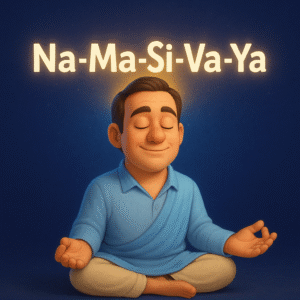
Posture: Sit steady, spine tall; soften jaw & throat.
Pace: Slow, resonant. Don’t force volume; feel vibration.
Placement (feel it travel):
- Om (crown → heart)
- Na–Ma (belly, pelvis)
- Śi (solar plexus)
- Va (heart center)
- Ya (throat → rest at the brow)
One round (slow):
Om … Na-Ma … Śi-Va-Ya … (smooth, unforced breath)
Count & Rhythm: 108 repetitions. Cycle: 40 days (one mandala).
After-glow: sit in silence for a minute; let the echo settle.
Verse 1 Na
Nāgendrahārāya trilocanāya | bhasmāṅgarāgāya Maheśvarāya | nityāya śuddhāya digambarāya | tasmai na-kārāya namaḥ śivāya ||
1. न (Na)–कार मन्त्र (Nagendrahārāya…)
| Sanskrit phrase | Literal meaning |
| नागेन्द्र-हाराय | to the One whose garland (हार) is the king of serpents (नागेन्द्र) |
| त्रिलोचनाय | the three-eyed One |
| भस्माङ्ग-रागाय | whose body (अङ्ग) is smeared (राग) with sacred ash (भस्म) |
| महेश्वराय | the great Lord |
| नित्याय | eternal |
| शुद्धाय | ever-pure |
| दिगम्बराय | “clothed with the directions,” i.e., sky-clad |
| तस्मै ‘न’-काराय नमः शिवाय | salutations to Śiva embodied in the syllable “Na.” |
Sense translation:
We bow to Śiva eternal, pure, sky-clad, three-eyed, and mighty whose very ornaments are king cobras and ash; He shines forth in the syllable Na.
Inner work: Detachment; witness-mind.
Verse 2 Ma
Mandākinī-salila-candana-cārcitāya | Nandīśvara-pramathanātha-Maheśvarāya | Mandāra-puṣpa-bahupuṣpa-supūjitāya | tasmai ma-kārāya namaḥ śivāya ||
2. म (Ma)–कार मन्त्र (Māndākinī-salila…)
| Sanskrit phrase | Literal meaning |
| मन्दाकिनी-सलिल-चन्दन-चर्चिताय | anointed with Ganga’s water (मन्दाकिनी-सलिल) and sandal paste (चन्दन-चर्चित) |
| नन्दीश्वर-प्रमथ-नाथ-महेश्वराय | the great Lord (महेश्वर), master of Nandī and the Pramatha gaṇas |
| मन्दार-पुष्प-बहु-पुष्प-सुपूजिताय | richly worshipped with mandāra blossoms and many other flowers |
| तस्मै ‘म’-काराय नमः शिवाय | salutations to Śiva in the syllable “Ma.” |
Sense translation:
We bow to Śiva lavishly worshipped with heavenly flowers, bathed in Ganga’s waters and sandalwood celebrated by Nandī and the gaṇa hosts; He resounds in the syllable Ma.
Inner work: Emotional cooling; cultivation of virtues.
Verse 3 Śi
Śivāya Gaurī-vadanābjavṛnda-sūryāya | Dakṣādhvara-nāśakāya | Śrī-Nīlakaṇṭhāya Vṛṣadhvajāya | tasmai śi-kārāya namaḥ śivāya ||
3. शि (Śi)–कार मन्त्र (Śivāya Gaurī-vadanābjavṛnda…)
| Sanskrit phrase | Literal meaning |
| शिवाय | to Śiva |
| गौरी-वदन-अभज-वृन्द-सूर्याय | sun (सूर्य) to the lotus-faces (अभज-वृन्द) of Pārvatī (गौरी) i.e., He makes them bloom |
| दक्ष-ध्वज-नाशकाय | destroyer of Dakṣa’s sacrifice |
| श्री-नीलकण्ठाय | the revered blue-throated One |
| वृष-ध्वजाय | whose banner bears a bull |
| तस्मै ‘शि’-काराय नमः शिवाय | salutations to the “Śi” in “Śiva.” |
Sense translation:
We bow to the blue-throated Lord on the bull-banner radiant like the sun to Pārvatī’s lotus face and the mighty destroyer of Dakṣa’s rite manifest in the syllable Śi.
Inner work: Transforming pain and habit loops into courage and clarity.
Verse 4 Va
Vaśiṣṭha-kumbhodbhava-Gautamārya- | munīndra-devārcita-śekharāya | candrārka-vaiśvānara-locanāya | tasmai va-kārāya namaḥ śivāya ||
4. व (Va)–कार मन्त्र (Vasiṣṭha-kumbhodbhava…)
| Sanskrit phrase | Literal meaning |
| वसिष्ठ-कुम्भोद्भव-गौतम-आर्य | honoured by sages Vasiṣṭha, Agastya (born from a pot, कुम्भोद्भव), and Gautama |
| मुनि-इन्द्र-देव-अर्चित-शेखराय | crowned One (शेखर) worshipped by great sages and gods |
| चन्द्र-अर्क-वैश्वानर-लोचनाय | whose eyes are moon, sun, and fire |
| तस्मै ‘व’-काराय नमः शिवाय | salutations to the “Va.” |
Sense translation:
We bow to Śiva whose three eyes are moon, sun, and fire, whose crest is adored by seers like Vasiṣṭha and Agastya and who radiates through the syllable Va.
Inner work: Wisdom that harmonizes mind, soul, and will.
Verse 5 Ya
Yakṣa-svarūpāya jaṭādharāya | Pināka-hastāya sanātanāya | divyāya devāya digambarāya | tasmai ya-kārāya namaḥ śivāya ||
5. य (Ya)–कार मन्त्र (Yakṣa-svarūpāya…)
| Sanskrit phrase | Literal meaning |
| यक्ष-स्वरूपाय | whose form is that of a yakṣa (celestial guardian) |
| जटाधराय | wearer of matted locks |
| पिनाक-हस्ताय | who holds the Pināka bow |
| सनातनाय | eternal |
| दिव्याय देवाय | the divine among gods |
| दिगम्बराय | clad only in the directions |
| तस्मै ‘य’-काराय नमः शिवाय | salutations to the “Ya.” |
Sense translation:
We bow to the eternal, sky-clad Lord of the Pināka divine guardian with matted locks whose presence resounds in the syllable Ya.
Inner work: Mastery and pure presence; truth that speaks itself.
Putting it together
The hymn honors Śiva through the five sacred letters Na-Ma-Śi-Va-Ya, praising a different facet of the Lord in every stanza. Reciting the stotra is thus a meditative journey across His cosmic, ascetic, and benevolent forms ending each time with “Namah Śivāya,” the essence of surrender.